 TradeTools
Electrical · in the TradeTools app
Breaker & Conductor Calculator
The standard-size overcurrent device for a load and the smallest copper or aluminum conductor that device may protect — with the continuous-load multiplier, the small-conductor caps and the next-size-up permission applied and named on the result.
NEC 210.20 · 240.4 · 240.6 App Store in review
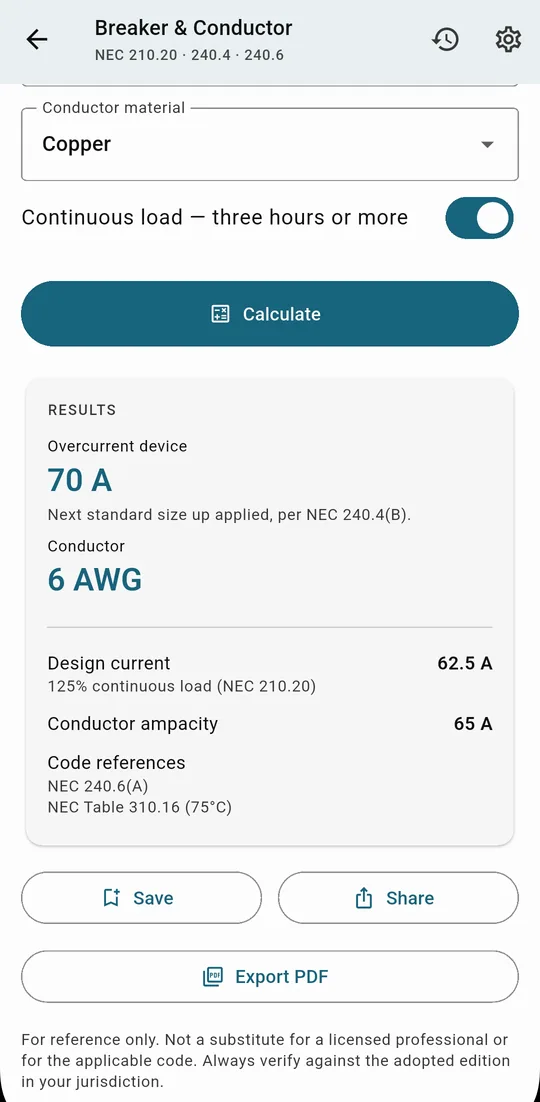
Worked example
50 A continuous load at 240 V, copper — what breaker, what wire?
| Load type | General |
|---|---|
| Load current | 50 A |
| Voltage | 240V |
| Phase | Single phase |
| Conductor material | Copper |
| Continuous load — three hours or more | on |
| Overcurrent device | 70 A — next standard size up applied, per NEC 240.4(B) |
|---|---|
| Conductor | 6 AWG |
| Design current | 62.5 A — 125 % continuous load (NEC 210.20) |
| Conductor ampacity | 65 A |
| Code references | NEC 240.6(A) · NEC Table 310.16 (75 °C) |
A continuous load is protected at 125 %: 50 × 1.25 = 62.5 A. The next standard rating in 240.6(A) is 70 A. 6 AWG copper carries 65 A in the 75 °C column of Table 310.16 — enough for 62.5 A — and because 65 is not a standard rating, 240.4(B) lets the 70 A device protect it. Had the load been 22 A on a 25 A device, 12 AWG's 25 A would not do: 240.4(D) caps it at 20 A of protection, and the result moves to 10 AWG and says why.
How it's calculated
The table behind the number
Design current is the load, times 1.25 when it is continuous (210.20(A)); an A/C load takes 175 % of rated-load current for the device (440.22(A)) and 125 % for the conductor (440.32), a welder 200 % for the device (630.12(A)). The device is the next standard rating at or above the design current, from 240.6(A) — except for A/C, where 175 % is a ceiling with no round-up, so the largest standard rating under it is used. The conductor is the smallest size in the 75 °C column of Table 310.16 that carries the design current and that the device may protect: for 14, 12 and 10 AWG that means the 240.4(D) caps of 15, 20 and 30 A (15 and 25 A for 12 and 10 AWG aluminum); for larger sizes the ampacity itself, or the next standard rating above it where the ampacity is not a standard rating and the device is 800 A or less (240.4(B)). A/C and welder conductors are left to their own articles, as 240.4(G) directs.
- NEC 2023 210.20(A)Continuous loads: the device rating not less than 125 % of the continuous load
- NEC 2023 240.6(A)Standard ampere ratings: 15, 20, 25, 30, 35, 40, 45, 50, 60, 70, 80, 90, 100, 110, 125 …
- NEC 2023 Table 310.16Allowable ampacities, 75 °C column (copper: 12 AWG 25 A, 10 AWG 35 A, 8 AWG 50 A, 6 AWG 65 A, 4 AWG 85 A)
- NEC 2023 240.4(B)Next higher standard rating permitted where the ampacity is not a standard rating, device 800 A or less, not a multi-outlet receptacle circuit
- NEC 2023 240.4(D)Small conductors: 14 AWG Cu 15 A, 12 AWG Cu 20 A, 10 AWG Cu 30 A; 12 AWG Al 15 A, 10 AWG Al 25 A
- NEC 2023 240.4(G)Article 440 and 630 circuit conductors are protected as those articles specify
Questions
Before you trust the number
Why 10 AWG on a 25 A breaker when 12 AWG is rated 25 A?
Table 310.16 gives 12 AWG copper 25 A at 75 °C, but 240.4(D)(5) caps its overcurrent protection at 20 A regardless of ampacity. A 25 A device therefore needs 10 AWG, and the result says so. The exceptions in 240.4(E) and (G) — tap conductors, motor, A/C and welder circuits — are the only way around it.
When does 240.4(B) not apply?
On a multi-outlet branch circuit supplying receptacles for cord-and-plug-connected portable loads, above 800 A, and wherever the ampacity already lands on a standard rating. The app assumes a single load; check the first condition yourself.
Why does an A/C load show a 35 A breaker on 12 AWG?
Article 440 sizes the two separately: the branch-circuit device may go to 175 % of rated-load current so it rides through starting (440.22(A)), while the conductor needs 125 % (440.32). 240.4(G) sends A/C circuit conductors to Article 440, so the 240.4(D) cap does not apply — which is why a nameplate can read MCA 25 A and MOCP 35 A, 12 AWG on a 35 A device.