 TradeTools
Carpentry · in the TradeTools app
Drywall Calculator
Sheets, joint compound, tape, screws and corner-bead footage for a room, from its length, width, height, doors, windows and whether the ceiling is finished too — a material estimate to adjust to your crew, not a code calculation.
 App Store in review
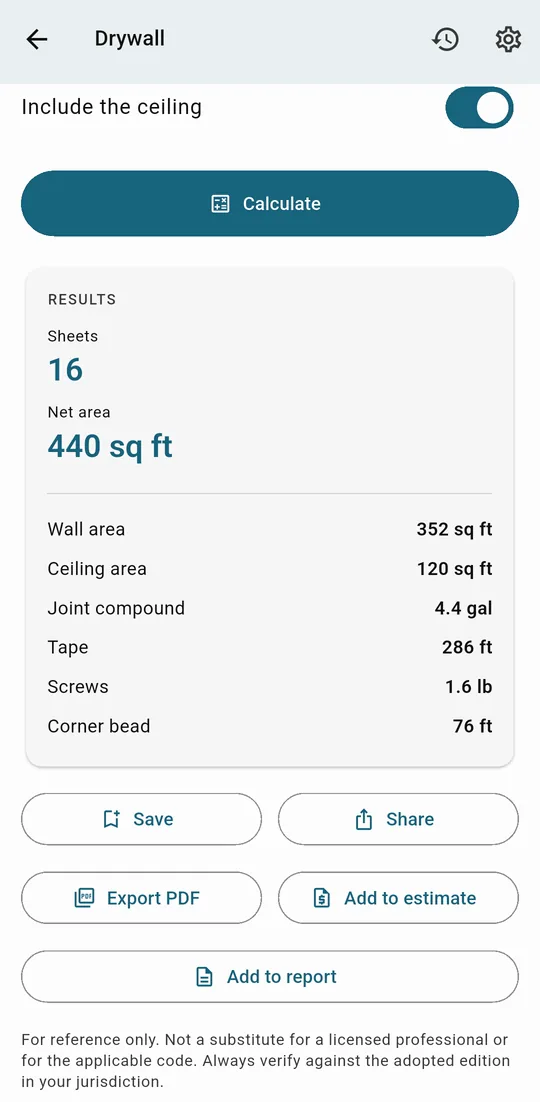
Worked example
A 12 × 10 ft basement room, 8 ft walls — how many sheets, and how much else?
| Room length | 12 ft |
|---|---|
| Room width | 10 ft |
| Wall height | 8 ft |
| Doors | 1 |
| Windows | 1 |
| Include the ceiling | Yes |
| Sheet size | 4×8 |
| Thickness | 1/2" |
| Sheets | 16 |
|---|---|
| Net area | 440 sq ft |
| Wall area | 352 sq ft |
| Ceiling area | 120 sq ft |
| Joint compound | 4.4 gal |
| Tape | 286 ft |
| Screws | 1.6 lb |
| Corner bead | 76 ft |
Wall area (2 × (12+10) × 8 = 352 sq ft) plus ceiling area (12 × 10 = 120 sq ft), less one door (20 sq ft) and one window (12 sq ft), nets 440 sq ft. With 10% waste, 440 sq ft divided by 32 sq ft per 4×8 sheet rounds up to 16 sheets. Joint compound is figured at 1 gallon per 100 sq ft (4.4 gal), tape at 0.65 ft per sq ft (286 ft), and screws at a fixed rate per sheet, converted to pounds (1.6 lb). These are calculator estimates — adjust them to your own crew's habits and the actual room. The 76 ft of corner bead is the room's four wall corners plus the ceiling perimeter; in a plain rectangular room like this one, that footage is all inside corners, which most crews tape rather than bead — bead is more commonly used on outside corners.
How it's calculated
The table behind the number
Wall area is the room's perimeter times the wall height; ceiling area, if the ceiling is included, is the room's floor area. Net area is the two combined, less the area of the doors and windows entered (20 sq ft for a default door, 12 sq ft for a default window). The number of sheets is the net area, plus 10% waste, divided by the sheet's coverage (32 sq ft for a 4×8 sheet), rounded up. Joint compound is figured at roughly 1 gallon per 100 sq ft of net area, and tape at about 0.65 linear ft per sq ft. Screws are figured at a fixed count per sheet, converted to pounds at a rate of 320 screws per pound. Corner-bead footage is the vertical wall corners plus the ceiling perimeter, for whichever corners the room and ceiling option produce — the tool reports the footage; whether a given corner takes bead or tape is a judgment call for the crew.
- Not a code calculationDrywall material quantities aren't a building-code table — this tool cites no code section. Waste factor, coverage rates and screw counts are calculator estimates built on the tool's own estimating assumptions; check them against your own takeoff and local practice.
Questions
Before you trust the number
Are these material quantities exact?
No — they're calculator estimates built on standard waste and coverage assumptions (like 10% waste and roughly a gallon of joint compound per 100 sq ft), meant to get you close fast. Adjust them to your own crew's habits and the actual room.
Is the 76 ft of corner bead really all corner bead?
In a plain rectangular room, that entire footage is inside corners — most crews tape those rather than run bead, which is used more often on outside corners. The number is the linear footage of corners in the room; the material for each one is your call.
Does this tool cite a building code?
No. Drywall material quantities aren't a code calculation, so this tool has no code reference.
What counts as the room's net area?
Wall area (perimeter times height) plus ceiling area, if you're finishing it, minus the door and window openings — 20 sq ft for a default door and 12 sq ft for a default window, adjustable to match the room.