 TradeTools
Plumbing · in the TradeTools app
Gas Pipe Sizing Calculator
The trade size of Schedule 40 pipe for a natural gas appliance's demand and the longest run from the meter to the most remote outlet, by the IFGC's longest-length method. Also sizes propane runs, the same way.
NFPA 54 · IFGC longest-length tables App Store in review
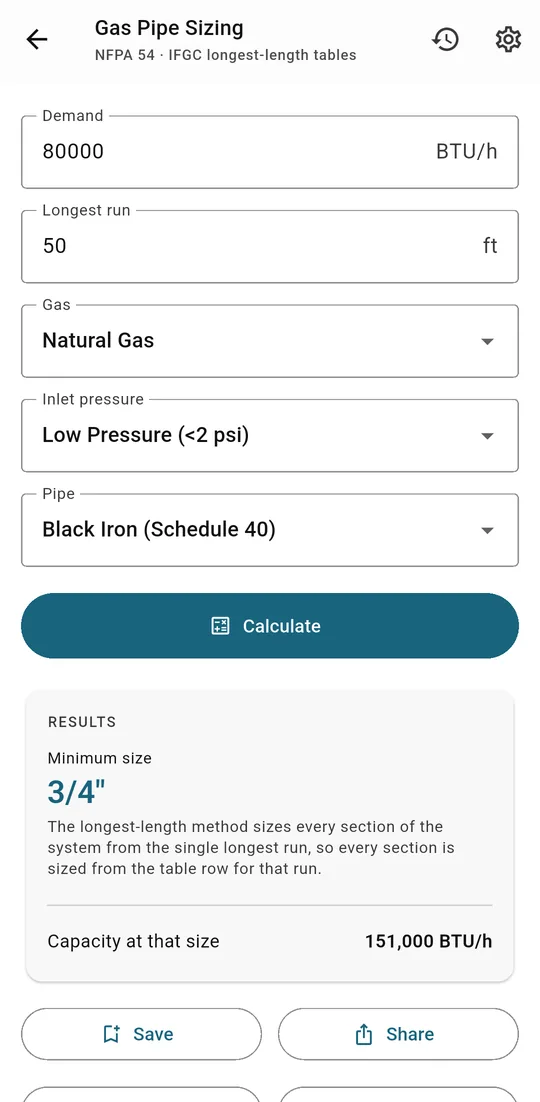
Worked example
80,000 BTU/h furnace, 50 ft of black iron from the meter — 1/2" or 3/4"?
| Demand | 80,000 BTU/h |
|---|---|
| Longest run | 50 ft |
| Gas | Natural Gas |
| Inlet pressure | Low Pressure (<2 psi) |
| Pipe | Black Iron (Schedule 40) |
| Minimum size | 3/4" |
|---|---|
| Capacity at that size | 151,000 BTU/h |
IFGC Table 402.4(2) — Schedule 40 pipe, natural gas, less than 2 psi, 0.5 in. w.c. drop — gives 1/2" only 72 CFH (about 72,000 BTU/h) at 50 ft, 8,000 short of the 80,000 the furnace needs; 3/4" gives 151 CFH, about 151,000 BTU/h. Natural gas is commonly taken as about 1,000 BTU per cubic foot, an assumption from IFGC Appendix A's own worked example — informative, not a mandatory value — so the table's CFH figures read as thousands of BTU/h; a gas utility's actual heating value can differ. The app's own note on this result reads: the longest-length method sizes every section of the system from the single longest run, so every section is sized from the table row for that run.
How it's calculated
The table behind the number
Demand is the sum of the connected appliances' maximum input — the rating on the nameplate, not the appliance's output (IFGC 402.2). The longest-length method sizes every section of piping from the longest length of pipe between the point of delivery and the most remote outlet, and the load that section carries (IFGC 402.4.1) — one length picks one row of the table for the whole run. The app looks up that row in the capacity table for the gas type, inlet pressure and pipe material selected, and reports the smallest trade size whose capacity at that length meets or exceeds the demand.
- IFGC Table 402.4(2)Schedule 40 metallic pipe, natural gas, inlet less than 2 psi, 0.5 in. w.c. pressure drop, specific gravity 0.60; at 50 ft, 1/2" = 72 CFH, 3/4" = 151 CFH — the same figures in both the 2018 and 2024 editions of the International Fuel Gas Code
- IFGC 402.4.1 — longest length methodEach section of gas piping is sized using the longest length of piping from the point of delivery to the most remote outlet, and the load of that section (2018 IFGC section numbering)
- IFGC 402.2 — maximum gas demandGas demand is the sum of the appliances' maximum input — the nameplate rating, not the output (2018 IFGC section numbering)
- IFGC Appendix A (informative)About 1,000 BTU per cubic foot for natural gas comes from Appendix A's own worked example — informative, not a mandatory value; where a run falls between two listed lengths, use the next longer one
Questions
Before you trust the number
Why 3/4" and not 1/2" for an 80,000 BTU/h furnace at 50 ft?
At 50 ft, IFGC Table 402.4(2) gives 1/2" pipe 72 CFH, about 72,000 BTU/h — 8,000 short of the 80,000 the furnace needs. 3/4" gives 151 CFH, about 151,000 BTU/h, which covers it.
What does the 80,000 BTU/h demand number mean?
It's the appliance's maximum input rating from its own nameplate, not its output — IFGC 402.2 defines demand as the sum of the connected appliances' maximum input.
What if the run falls between two lengths on the table?
Use the next longer length listed, never round down to the shorter one — that's the reading method IFGC's own informative appendix gives for its capacity tables.
Does 1,000 BTU per cubic foot always hold for natural gas?
It's IFGC Appendix A's own worked-example assumption, and a common approximation — but a gas utility's actual heating value can run higher (the U.S. average was about 1,037 in 2025), so the table's CFH figures are read as thousands of BTU/h, not converted exactly.