 TradeTools
Electrical · in the TradeTools app
Transformer Calculator
Primary and secondary full-load current for a single- or three-phase transformer, the overcurrent devices Table 450.3(B) permits, and the copper or aluminum conductors that carry 125 % of the current and can be protected by those devices.
NEC 450.3(B) · Table 450.3(B) App Store in review
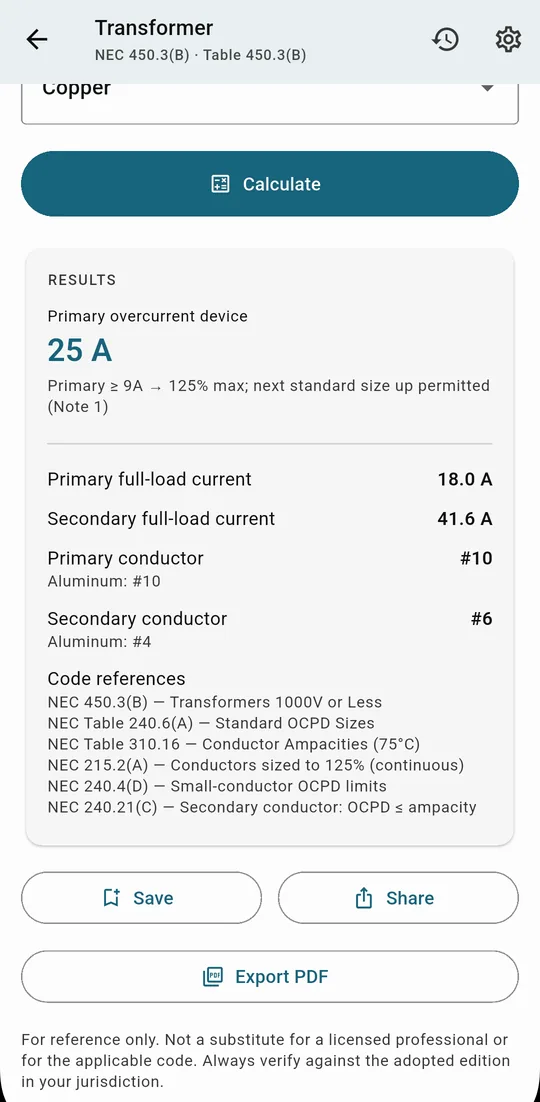
Worked example
15 kVA, 480 V to 208Y/120 V, three-phase, primary-only protection — what device, what conductors?
| Transformer rating | 15 kVA |
|---|---|
| Primary voltage | 480 V |
| Secondary voltage | 208 V |
| Phase | Three phase |
| Protection | Primary only |
| Conductor | Copper |
| Primary overcurrent device | 25 A — primary ≥ 9 A: 125 % max, next standard size up permitted (Note 1) |
|---|---|
| Primary full-load current | 18.0 A |
| Secondary full-load current | 41.6 A |
| Primary conductor | #10 (aluminum: #10) |
| Secondary conductor | #6 (aluminum: #4) |
| Code references | NEC 450.3(B) · Table 240.6(A) · Table 310.16 · 215.2(A) · 240.4(D) · 240.21(C) |
15 000 VA over 480 × √3 is 18.04 A on the primary, 41.64 A on the 208 V secondary. Primary-only protection at 9 A or more allows 125 %: 22.55 A, and Note 1 lets that round up to the next standard rating, 25 A. The primary conductor must carry 125 % of 18.04 A — 22.55 A — which 12 AWG copper does on Table 310.16; but 240.4(D) caps a 12 AWG at 20 A of protection, so a 25 A device needs 10 AWG. The secondary conductor carries 125 % of 41.64 A, 52.05 A: 6 AWG copper at 65 A.
How it's calculated
The table behind the number
Full-load current is VA over volts for single-phase, VA over volts times √3 for three-phase. With primary-only protection, Table 450.3(B) allows 125 % of primary current at 9 A or more (Note 1: the next higher standard rating is permitted), 167 % between 2 and 9 A and 300 % below 2 A — the last two are ceilings, with no rounding up. With primary and secondary protection the primary may go to 250 % and the secondary to 125 % (Note 1) at 9 A or more, or 167 % below. Conductors are sized at 125 % of the full-load current (215.2(A)(1)) in the 75 °C column of Table 310.16, and each must be one its device may protect under 240.4 — including the 240.4(D) caps on 14, 12 and 10 AWG. The primary conductor may use the 240.4(B) next-size-up allowance; a secondary conductor may not, because 240.21(C) does not permit 240.4(B) for transformer secondary conductors.
- NEC 2023 450.3(B), Table 450.3(B)Transformers 1000 V and less — primary only: 125 % (9 A and up, Note 1), 167 % (2 to 9 A), 300 % (under 2 A); primary and secondary: 250 % primary, 125 % secondary
- NEC 2023 240.6(A)Standard ampere ratings
- NEC 2023 Table 310.1675 °C column (12 AWG Cu 25 A, 10 AWG 35 A, 6 AWG 65 A; 10 AWG Al 30 A, 4 AWG Al 65 A)
- NEC 2023 240.4(D)Small-conductor caps: 12 AWG Cu 20 A, 10 AWG Cu 30 A, 10 AWG Al 25 A
- NEC 2023 215.2(A)(1)Feeder conductors sized to 125 % of the continuous load
- NEC 2023 240.21(C)The 240.4(B) next-size-up allowance is not permitted for transformer secondary conductors
Questions
Before you trust the number
Why is the primary conductor 10 AWG when 18 A would fit 14 AWG?
Two steps up. The conductor must carry 125 % of the full-load current — 22.55 A — which rules out 14 AWG at 20 A. 12 AWG carries 25 A, but 240.4(D) caps its overcurrent protection at 20 A and the primary device here is 25 A. The first size a 25 A device may protect is 10 AWG. This case came from an electrician who checked a transformer sizing against the book; the fix cites 240.4(D) on the result.
Primary only, or primary and secondary?
Primary only means the device ahead of the transformer is the only protection and is held to 125 % of primary current (9 A and up). Add a secondary device rated at 125 % of secondary current and the primary device may rise to 250 % — the usual arrangement for a 480 to 208Y/120 transformer feeding a panel. The conductors follow the devices you choose.
Does the secondary conductor get the next-size-up allowance?
No. 240.21(C) states that the next-size-up provision of 240.4(B) is not permitted for transformer secondary conductors, so the app sizes the secondary conductor at least as large as its device. A 60 A secondary device on 6 AWG (65 A) passes; 300 A on 300 kcmil (285 A) does not, and the app moves to 350 kcmil.