 TradeTools
HVAC · in the TradeTools app
Duct Sizing Calculator
The round duct for an airflow at a friction rate, the rectangular duct equivalent to it, and the velocity that results — from the friction-chart equation rather than a rule of thumb.
ACCA Manual D · ASHRAE friction chart App Store in review
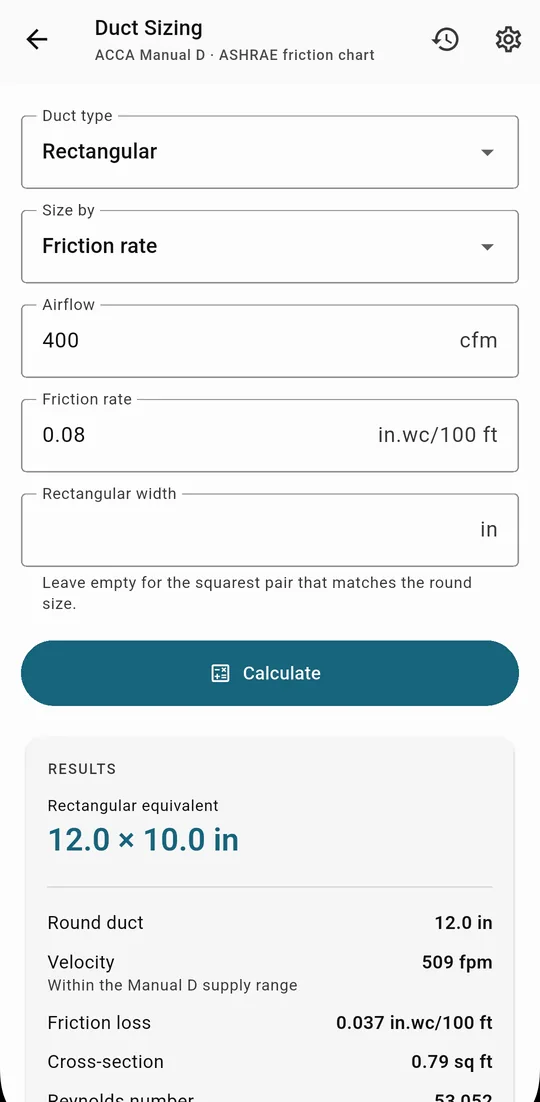
Worked example
400 CFM at 0.08 in. w.g. per 100 ft — what size duct?
| Duct type | Rectangular |
|---|---|
| Size by | Friction rate |
| Airflow | 400 cfm |
| Friction rate | 0.08 in.wc/100 ft |
| Rectangular width | left empty |
| Rectangular equivalent | 12.0 × 10.0 in |
|---|---|
| Round duct | 12.0 in |
| Velocity | 509 fpm — within the Manual D supply range |
| Friction loss | 0.037 in.wc/100 ft |
| Cross-section | 0.79 sq ft |
| Reynolds number | 53,052 |
Solving the friction equation for 400 CFM at 0.08 gives a 10.3 in diameter; the next standard round size is 12 in. At 12 in the same airflow runs 509 FPM, inside the 400–900 FPM range Manual D uses for residential supply, and the friction drops to 0.037 in. w.g. per 100 ft. The squarest listed pair equivalent to 12 in round is 12 × 10.
How it's calculated
The table behind the number
By friction rate: the ASHRAE friction equation for galvanized round duct, ΔP = 0.109136 · Q^1.9 / D^5.02 (in. w.g. per 100 ft, Q in CFM, D in inches), is solved for D and the result rounded up to the next standard round size. By velocity: area is CFM over the target FPM, and the diameter follows. Velocity, friction loss and Reynolds number are then recomputed at the standard size, and the velocity is checked against the 400–900 FPM residential supply range of Manual D. Rectangular equivalents come from the Huebscher equivalent-diameter equation, De = 1.30 (ab)^0.625 / (a + b)^0.25, from a list of pairs with aspect ratio up to 4:1; give a width and the app returns the listed pair nearest it. Flex duct is sized 10 % larger in diameter and rounded up to the next standard size, for its higher friction.
- ASHRAE Handbook — Fundamentals, Duct DesignFriction equation for galvanized round duct and the Huebscher equivalent-diameter equation
- ACCA Manual DResidential supply velocity range 400–900 FPM; the design friction rate comes from the equipment's available static pressure and the total effective length — 0.08 in. w.g. per 100 ft is the app's default
Questions
Before you trust the number
Why is the friction loss 0.037 when I asked for 0.08?
Because the duct was rounded up. The equation asks for 10.3 in; the next size on the shelf is 12 in, and at 12 in the same 400 CFM loses only 0.037 in. w.g. per 100 ft. The design friction rate is a ceiling, not a target.
Where does the friction rate come from?
From the equipment. Manual D takes the external static pressure the blower can deliver, subtracts the coil, filter, registers and other components, and divides what is left by the total effective length of the longest run. 0.08 is a common residential starting point and the app's default; enter your own when you have the worksheet.
Can I get a different rectangular shape?
Enter the width you can fit and the app returns the listed pair nearest that width — 16 × 8 or 18 × 8 in place of 12 × 10 for the same 12 in round — each within 8 percent of the same equivalent diameter.