 TradeTools
Electrical · in the TradeTools app
Dwelling Load Calculator
Sizes a brand-new service or a full replacement, or checks whether one you already have has room for one more load — the existing-service check this page covers, under NEC 2023 220.83(A).
NEC 220.82 · 220.83 App Store in review
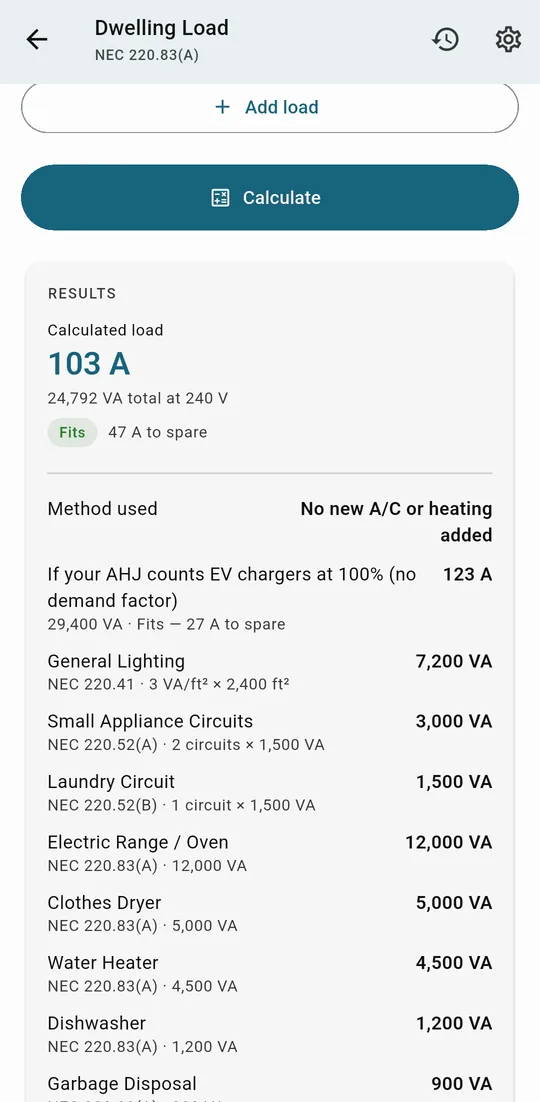
Worked example
Will a 150 A panel take an EV charger, along with everything already in the house?
| New or existing service? | Existing service |
|---|---|
| Service or feeder rating | 150 A |
| Conditioned floor area | 2,400 sq ft |
| Existing loads (summary of six entries) | Range/oven 12,000 VA · dryer 5,000 VA · water heater 4,500 VA · dishwasher 1,200 VA · disposal 900 VA · 3-ton A/C 7,000 VA |
| Added load | EV Charger, 7,680 VA |
| Calculated load | 103 A — 24,792 VA total at 240 V · Fits, 47 A to spare |
|---|---|
| If your AHJ counts EV chargers at 100% (no demand factor) | 123 A — 29,400 VA, Fits with 27 A to spare |
NEC 2023 220.83(A) checks whether an existing service has room for one more load, rather than resizing the whole house: it counts the first 8,000 VA of the total in full and the rest at 40%. The app floors an EV charger's demand at 7,200 VA under 220.57 when the nameplate rating is lower. Reading it that way, adding a 7,680 VA charger to this house's existing loads comes to 103 A against the 150 A panel — Fits, 47 A to spare. Some AHJs count an EV charger at 100%, with no demand factor; the app shows that reading too — 123 A, still Fits, 27 A to spare. Either reading checks the panel's rating only; the service or feeder conductors get their own check under NEC 310.12.
How it's calculated
The table behind the number
The app totals general lighting (3 VA per sq ft, NEC 220.41), the small-appliance and laundry circuits, and every other existing load, then adds the load being checked — floored at its nameplate rating or 7,200 VA under 220.57, whichever is higher, for an EV charger. Under NEC 2023 220.83(A), the first 8,000 VA of that total counts at 100% and the remainder at 40%; the result is compared against the service or feeder rating entered. Because some jurisdictions read an EV charger at 100% with no demand factor instead, the app shows that alternative reading as a second number, checked against the same panel rating. A disclaimer on the result notes that this checks the panel's rating only — old or undersized service conductors need their own check under NEC 310.12 — and that 220.83 is an optional method an AHJ may apply differently.
- NEC 2023 220.83(A)An optional method for checking whether an existing service or feeder has room for one added load: the first 8,000 VA of the total load counts at 100%, the remainder at 40%
- NEC 220.57An electric vehicle charger's demand load is its nameplate rating or 7,200 VA, whichever is greater
- NEC 310.12The rating of a service or feeder is a separate question from whether its actual conductors have the ampacity for that rating — checked on its own
Questions
Before you trust the number
Does 220.83 size a service from scratch?
No — it's an optional method for checking whether a service or feeder already in place has room for one added load, not for sizing a fresh installation.
Why does the app floor an EV charger at 7,200 VA?
The app uses 220.57's figure per charger: nameplate or 7,200 VA, whichever is larger — here 7,680.
Why does the app show two different amp readings for the same panel?
Because AHJs read EV chargers differently: 220.83(A) applies its usual demand factors, but some AHJs count a charger at 100% with no demand factor. The app shows both readings against the same panel rating.
If the panel's rating fits, is the wiring automatically fine too?
Not necessarily. This check compares the load against the panel's rating; the service or feeder conductors that actually supply it have their own ampacity check under NEC 310.12, which this tool doesn't perform.